Tuesday, 13 November 2018

Spring has sprung

Spring on Macquarie Island is heralded by the arrival of hundreds of mature bull elephant seals. Those in the prime of mating potential (usually around 10-12 years old) battle it out for control over a patch of beach. Their fights are short but vicious, with most sporting an array of old scars, fresh wounds, and bits of missing nose. Those successful are named 'beach masters' and they spend the next few weeks holding on to their little patch of territory until the arrival of their harems.

Right on a cue, the ladies arrive. Thousands of female elephant seals, heavy with pregnancy, haul themselves out of the waves to take up residence in their harem of choice. They leave it right until the last minute, and often it's only a day or two from when they arrive until when they give birth.

Birthing itself is over in under a minute and a 10kg barking pup in oversized skin adds to chaos. The noise coming from these harems is incredible. Within 5-6 weeks the 10kg has become 40kg (I can only imagine the calorie content of elephant seal breast milk) and the pup becomes a weaner. After that the females get a rather brutal re-impregantion (no rest for the wicked) and head out to sea again to replenish some of the weight they have lost. Meanwhile the weaners take up residence all over station, causing havoc and getting into every imaginable nook and cranny.

That's where we are up to at the moment, but come early late November/early December they'll be hungry enough that they decide it's time to learn how to swim.

Until the next installment...

Back in early September the bulls starting arriving and selecting their prime bits of coastline. This one decides I'm there to steal his patch and has a bit of a roar. I leave him to it.

A small break in the fighting and a bit of an itch to sort out. Very Jabba the Hutt.

Back to the fighting. The size and bulbous-ness of the nose indicates the maturity of the bull. This one is definitely in his breeding prime. A couple of scuffs as evidence to his recent fights.

A view down the east coast beaches near station - each harem is spread along 50-150m, with a gap before the next one. The mums are the light brown colour and pups are dark brown/black. The beach master is in the middle towards the back. Challenges from other bulls are frequent, so any good beach master sleeps with one eye open.

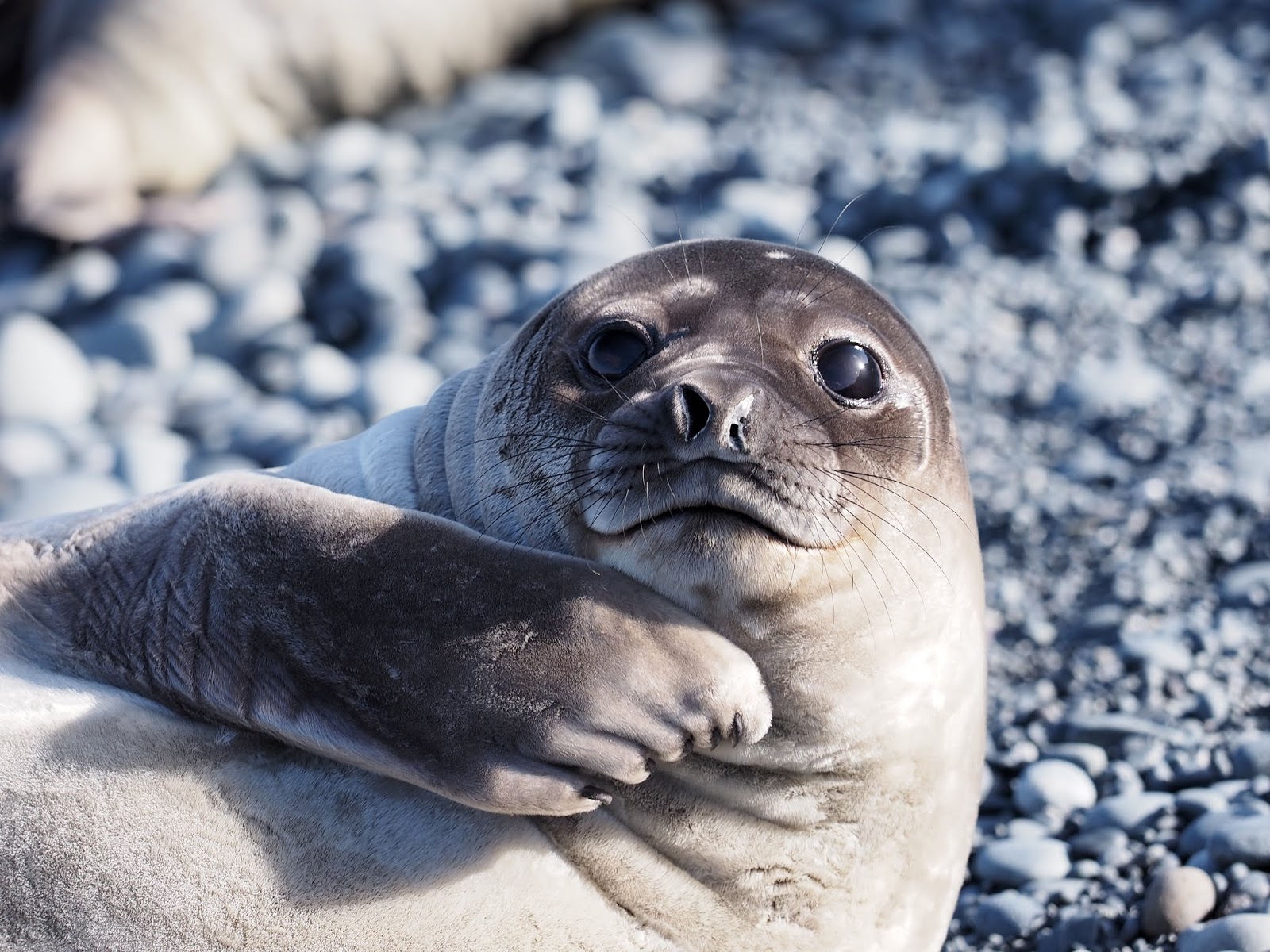
Too cute. It's hard to imagine this little chap growing into a 3-tonne blubber slug.

Lots of excess skin to grow into. Just as well, I don't think their skin could stretch fast enough to accommodate how quickly they grow.

Milk bubble dreams

They seem to feed almost non-stop for the first few weeks. A rare reprieve for mum - just long enough to digest a bit.

And before you know it, baby buddha emerges. This pup is probably 5-6 weeks old compared to those above who are around 1-2 weeks. The transformation is pretty profound.

Now that there are weaners around (meaning some females are back on heat) things hot up again with the beach masters. Surprisingly most challengers back down after a solid period of roaring, and you don't see as many physical fights as I thought there would be.

Of course the Orca now arrive. They know weaner feasts aren't too far away.

Gratuitous cute shot number 1: A slightly only weaner, working his blue steel

Gratuitous cute shot number 2: Working the upside down look

Gratuitous cute shot number 3: Trying out his very threatening roar

Wednesday, 31 October 2018

Go Go Gadget's


With the end of winter and the upcoming arrival of our summer expeditioners, the bi-annual mission to dig out Gadget’s Gully Dam has been on the to-do list for the last few weeks. All of our water on station is sourced from this dam and piped down the hill approximately 1.5km into our station tanks. The dam is filled by surface water from the plateau, and with the water comes a steady supply of sediment, rocks and mud which means a major dig out operation is required a couple of times each year.

Being a little bit lacking in the upper body strength department (and a lot lacking in the shovel-skill department) I felt comfortable in the presumption that there was no way I would be called on for the task.

But of course, when it turns out there are only 4 of you who are available for the job (not in the field and not on the fire team), upper body strength and shovelling abilities suddenly don’t count for much.

‘Team Gadgets 2018’ (Tim – our carpenter/BSS, Greg – our plumber, Danielle – one of our meteorological observers, and myself – the doctor) were up bright and early last Tuesday morning, hoping for a lovely sunny and wind-free day, but of course getting dense fog, bouts of rain, and the usual 20-30 knots of wind.

On initial inspection we thought it didn’t look too bad, but of course that was before we drained all the water out and realised that what we optimistically took for rock was in fact, quite a lot of mud. At that stage the only thing to do was to start shovelling. And shovel we did, for the next 6 hours or so (with the odd break for cups of tea and general cursing) until bedrock was hit and the job was done!

Team Gadgets (plus Danielle taking the photo) leave station equipped and trying to muster enthusiasm

Gadget’s Dam on our arrival. Doesn’t look too bad does it? Shame about the weather.

Tim, Greg and Danielle discuss the approach “We’ll drain it and then we’ll dig it out” while I document the momentous occasion.

Plumber Greg disconnects the station water supply line (heading over the hill on the left side of the frame) and the dam drain commences.

Ok, a bit more mud than we thought…

I get the digging while Tim throws water around

Tim and Greg encourage a lot of mud through a rather small hole in the base of the dam. A lot easier than bucketing it over the top which we originally tried....

Look at that shovel full. Not my happy place.

I get sick of digging and take up scrubbing. The dam wall does come up nicely.

Danielle in her not-so-yellow-anymore waterproofs, proudly standing by the finished product – check out that exposed bedrock! 

Tuesday, 16 October 2018

The island sushi train is pulling into station

Since pretty much the beginning of the year, I've been harping on about having a sushi train. We had one at Casey Station and it was great fun, even though the 'train' was a couple of trays on caster wheels and we just pulled it up and down the table.

For as long as I've been harping on about it, our Ranger (Chris) has been dropping very unsubtle hints about a top secret woodwork project he has had on the go; maybe a sushi train, maybe not.

After many months of talk and not a lot of action, we finally set the date for the last weekend of September. Because Chris wasn't quite sure he'd get his secret masterpiece finished on time, it was widely publicised that there would be some sort of event on that weekend; maybe a sushi train, maybe not.

Fortunately he pulled out all the stops, and the Macquarie Island sushi train really was not only finished on time, it exceeded expectations in every way. Danielle assisted with some stunning tunnel artwork, and Chef Annette and I got busy in the kitchen creating all manner of Japanese deliciousness.

So in the end the worst kept secret of the year was a riotous success of both hobby skills and cooking.

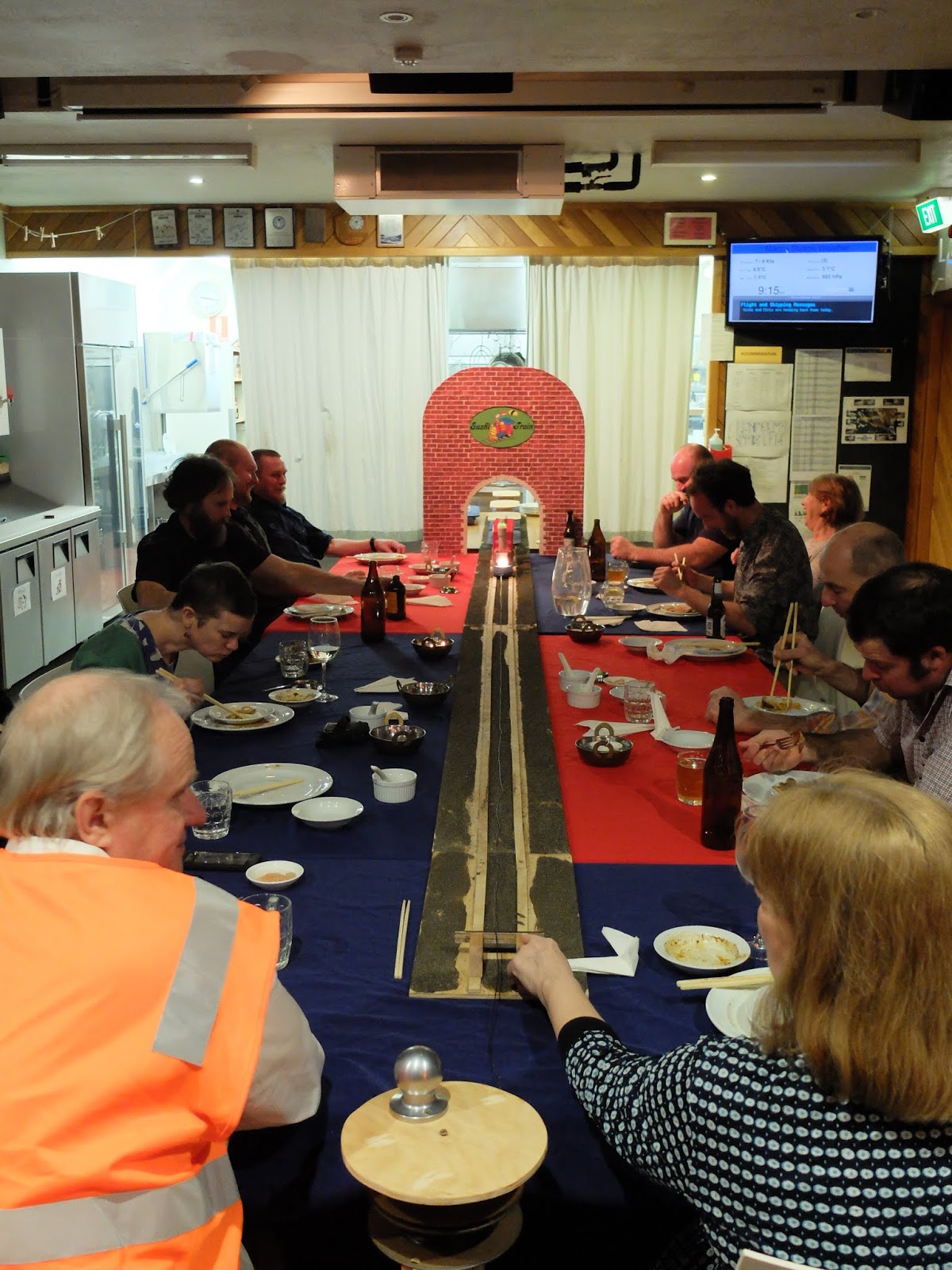
The Macquarie Island Sushi Train in all its splendour

But back to earlier in the day....Chef Annette prepares the dumplings

While Ranger Chris sorts out the table settings

I'm roped into the fray to make sushi - thank goodness our hydroponic garden has been producing lots of cucumbers recently

The sushi line up waiting to board the first train of the evening

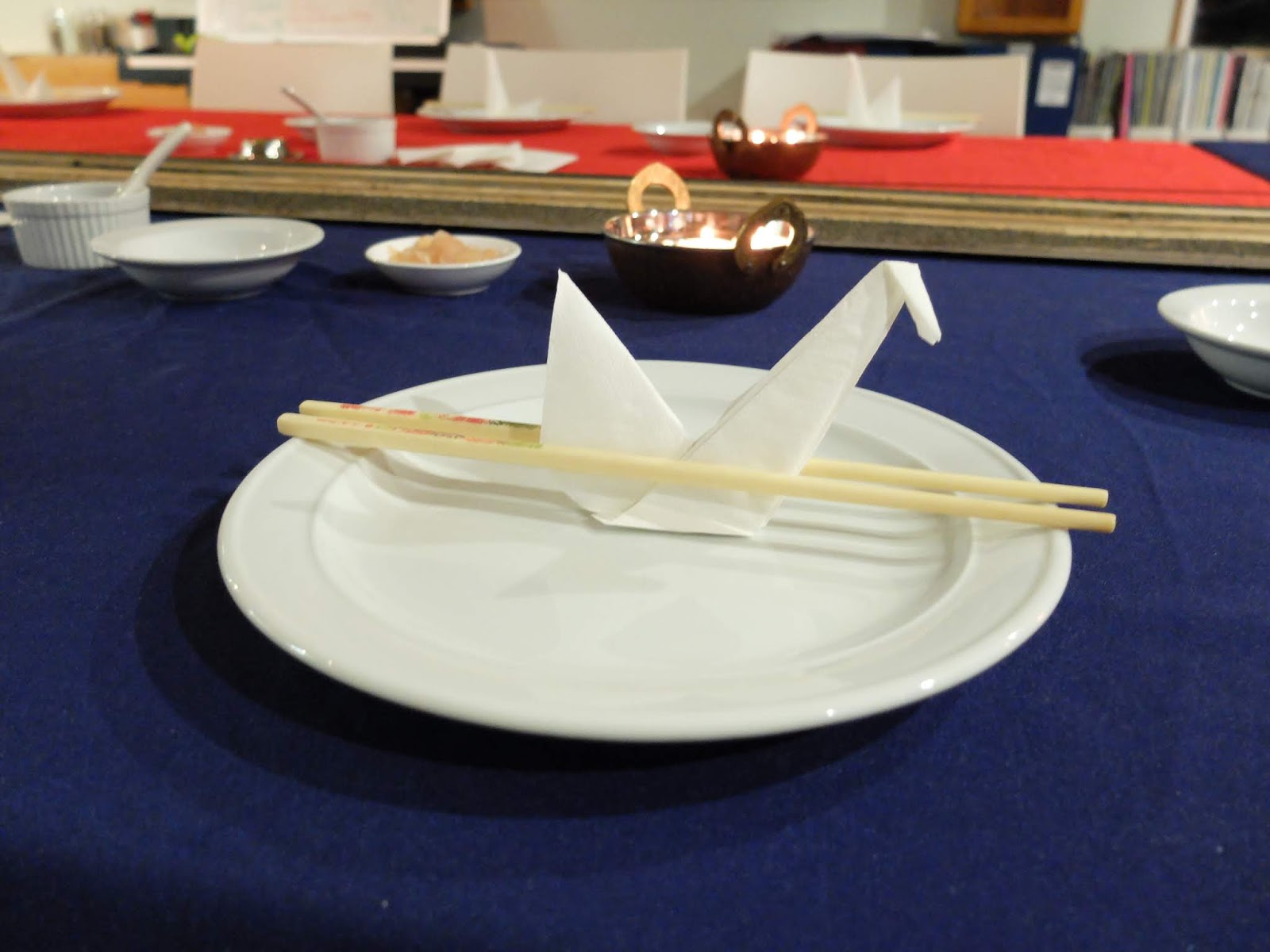
Ranger Chris sorts out his origami napkin folding after a half hour of googling

Jez tries to decide what he'll have first

Pete takes on the role of conductor/driver and spends most of the night winding the train up and down the table. Ali keeps an eye on proceedings.

Just course number 4 of 6 - tempura seafood. Mmmm.

Toot toot

So much choice. Greg and Rich decide on dessert.


Monday, 24 September 2018

How to hut - Macquarie Island style


For the average Australian Antarctic (or sub-Antarctic) expeditioner, heading off station for a few days to visit a field hut is one of the many pleasures of our year south. While commonly recreational trips, there is also a range of maintenance and repair jobs needed to keep each hut in top notch condition.


Here on Macquarie Island, we have five full field huts dotted around the coast, and one additional shelter (almost as good as a hut, but lacking a few of the luxuries). Most people spending a year here will try to get to each hut at least once, which is no mean feat when the main transport method is foot and the island is almost 13,000 hectares of mud, tussock and hills.

In order to keep everything running safely and smoothly, there are certain things you do when arriving and leaving a hut. No one wants to be the person who forgets to turn off the water valve and freezes the hut supply line, so we all listen attentively to our handy Field Training Officer (FTO) who gives us the run down during our first trip out. After that, individual hut routines are finessed with each passing trip, and by the end of the year we’ll all have it down to a fine art.

So, with some help from my trusty fellow expeditioners, here is ‘How to hut – Macca styles’.


Hoorah, first view of Hurd Point Hut. This hut is right at the southern end of the island so it takes a bit to get there. After 2 days and 34km of walking, it's definitely time for a cuppa!

But before rushing in to put the kettle on, there's a few things to take care of. First thing is to get the power on. Each hut has a RAPS unit (remote area power source) which uses solar and wind energy to provide us with power. Here at Green Gorge Hut, Angus turns on the unit while Pete makes a beeline for the hut.

Safety never rests, and an AAD expeditioner always checks the hut vents are open. Each hut also comes equipped with two different carbon monoxide monitors, so we are pretty sorted in that area.

With the vents open that cuppa is one step closer. Next step is getting some gas to heat the water. Here at Waterfall Bay Hut I open the LPG cylinders.

Most huts have plumbed cold water from a rain tank outside, and on arrival you open the outlet valve from the tank. David Point Shelter is a little more rustic, so filling up the kettle involves Chris popping to the tank outside. Still pretty luxurious, although note the hut itself is the rather tiny converted water tank on the left hand side (the wooden structure is just a storage shed). Standing room for one only!

Finally inside with wet boots drying and a change a clothes on, the kettle is boiling while Tim whips up something tasty at Brothers Point Hut.

And a day or two later it’s time to pack up and go home. We do it all in reverse and then leave Bauer Bay hut clean and tidy for the next trip.

Hoorah, another successful Macquarie Island field trip! Back up the hill we go.

Friday, 7 September 2018

In aid of comms

While no one job here on Macca is any more or less important than another, I have to admit that our comms tech, Norbert, is rather busy man. One of his many jobs is keeping the 3 VHF radio repeaters working, so we can communicate up and down island during the various field trips we all enjoy.

Two of the repeaters are within a fairly easy distance of station, but one is right down the bottom of the island, on top of one of our highest peaks, Mount Jeffryes.

A couple of weeks ago Norbert was looking for volunteers to accompany him on a maintenance mission to this particular spot, and not really knowing what I was getting myself into, I happily volunteered. Our chef, Annette, joined us to make a party of three.

We worked out our route, put in our trip application, packed some essentials (mainly wine and cheese) and a few days later we were off.

In fairness it was actually a great trip - 6 days in total and 3 of them were sunny and less than 15 knots (unheard of!) but a 65km round trip for an hour's routine maintenance on an aerial does seem a bit much. Thankfully it's a once a year job, so no more Mount Jeffryes for me!

Day one dawned with blue skies and hardly any wind. What a treat! Heading south down the main overland track.

Still looking fresh at this stage. And the first day of Macca hiking that I haven't had to wear full wet weather gear.

Day two, and yet more fair weather. Woohoo! This is taken outside Brother's Point Hut looking north up the island (towards station).

Climbing up out of Sandy Bay where Brothers Point Hut is located. The two offshore rocks in the background are known as The Nuggets, and most days are hidden in mist and fog.

No matter the weather, you can't escape 'Buzzy'. Formally known as Acaena magellanica, Buzzy is a notorious and widespread Macca plant which takes any opportunity to stick itself to every possible item of clothing it touches, and is impossible to remove. Once touched, you spend the next few hours trying to pick it out of your gloves while getting stabbed by its hundreds of tiny spikes. 
 
Annette making her way through a rather picturesque and Buzzy-free valley on day 2

From the top of the track down into Waterfall Bay. Our hut for night 2 is somewhere down on the coastline.

Norbert and Annette clambering down the Jesse Niccol jump-down into Waterfall Bay, not far to go for the day now.

And lo and behold, here is Waterfall Hut. It's another pre-fabricated 'googie' or 'smartie', similar to Brothers Point Hut. The rest of the huts on the island are individually build and each unique.

And after a lovely night at Waterfall Bay, it's time to go uphill again. Annette makes her way up the Mt Martin jump-up.

About half way I stop for a breather. Honestly, who thought putting a track up these gradients was a good idea?

But you do get some great views. Looking down into a maze-like elephant seal wallow area. In a few weeks this area will be filled with breeding harems.

Back up on top of the plateau, you get some pretty great natural terrace formations

And even more cool, over hundreds of years the gravel stratifies itself out by size so you get a striped pattern - something to do with repeated freezing and thawing, but the explanation was a bit lost on me...
A view down island over one of the terraced areas - our destination is Mount Jeffryes, just to the right of centre in the background

And finally, on day 3 we reach the repeater - the aerial is on the highest part of the hill and the associated comms tech guff is in the shelter to the right.

But being one of the islands highest points, it's rather cold up here!

Brrrrrr....

Norbert gets busy with the job as Annette and I do star-jumps and jogging on the spot to keep warm

An hour later the job is done we head for home - another 3 days back to station but this time rain, hail, snow and 40 knot winds (the Macca we know and love).

It's been a fabulous trip around the sun. The final entry.

As quickly as it started, it has all come to a finish.  The Aurora Australis arrived at Macquarie Island in early March, bring this yea...